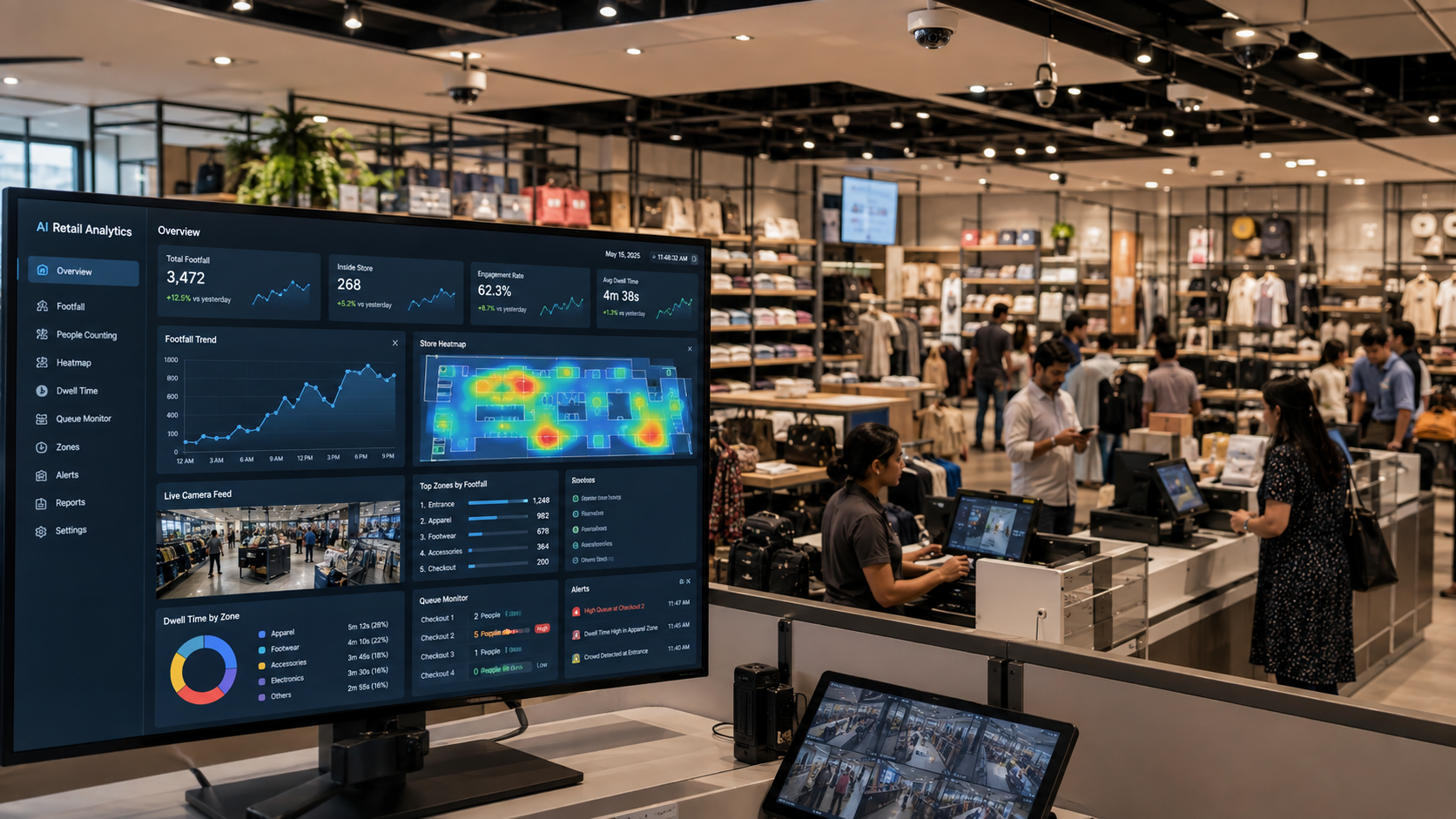
AI-powered CCTV is bringing data-driven intelligence to offline retail by turning store cameras into real-time sources of operational and customer insights. This technology helps physical stores move beyond manual monitoring and make smarter, faster decisions similar to digital retailers.
How AI-Powered CCTV Is Transforming Offline Retail in 2025
Abstract/ TL;DR:
For years, e-commerce had dashboards, real-time insights, and operational intelligence while physical stores ran on manual checks and gut feel.
AI-integrated CCTV is now closing this gap, giving offline stores the same analytical power that digital businesses have enjoyed for a decade. This shift could redefine how retail operates in 2025 and beyond.
In discussions about the future of retail, most narratives swing between two poles:
e-commerce’s explosive rise and the enduring presence of traditional offline stores. But there is a third — and perhaps more important — story unfolding quietly beneath the surface: offline retail is finally getting its own dashboards. And this could be the most transformative shift in the sector in years.
Why Visibility Became the Real Competitive Edge
For over a decade, the biggest advantage e-commerce businesses had on top of convenience or speed is visibility.Online platforms have sophisticated systems that tell them, in real time:
what’s selling,
what’s running low,
where demand is shifting,
how operations in fulfillment centers are performing,
what products are returning more than average.
Every piece of activity feeds a dashboard that helps decision-making, forecasting, and optimization.
Offline stores, in contrast, have traditionally operated with limited visibility. Inventory counts are manual. Footfall is estimated. Shelf performance is inferred. There’s no real-time recording of what’s happening moment-to-moment.This is a big structural gap in operational intelligence.
Data is the Engine of Growth Across industries, decision-making is shifting from intuition to data:
Firms using data-driven decision making are 6% more productive and 5% more profitable than their competitors. (McKinsey)
Retailers with integrated analytics saw 15–20% improvements in inventory turns
and 30–40% reductions in stockouts. (Deloitte)
Yet for years, offline retail lacked the basic tools to collect such data in real time.
AI-Powered CCTV: Turning Every Store Into a Sensor Grid
The rise of AI-integrated CCTV is now changing that. What was once merely surveillance footage has become a rich source of operational intelligence.
With the application of computer vision and machine learning:
Cameras can now track product movement on shelves.
AI can detect out-of-stock situations, even before a customer notices.
Billing discrepancies are flagged in real time.
Footfall patterns and customer behavior heatmaps can be generated without manual sensors.
Employee activities (like restocking times or register interactions) can be analyzed for workflows.
This making sense of data that was previously invisible is playing a big role in offline stores rising at par.
Why This Matters Now More Than Ever
Offline retail still dominates much of the market:
Despite e-commerce growth, the vast majority of retail transactions globally and in markets like India still happen offline — often over 80% of total retail sales.
The offline network — kirana stores, neighbourhood retailers, small chains — remains deeply embedded in consumer habits and last-mile commerce.
This means that improving the operational intelligence of offline stores could be a massive opportunity for stores operating offline Intin solution Jarvis Brings Dashboards to Offline Retail
Intin’s Jarvis exemplifies how offline stores can finally operate with the same level of insight that digital platforms have enjoyed.
Here’s what Jarvis makes possible:
Real-time analytics from existing CCTV infrastructure — no need for expensive sensors.
Automated inventory visibility, reducing shrinkage and stockouts.
Operational performance metrics, including staff workflows and billing accuracy.
Customer behavior analysis, without invasive tracking or extra hardware.
By turning video into actionable data, offline retail stores can:
reduce inefficiencies,
improve customer experience,
optimize stock levels,
and make data-driven decisions that previously required expensive software ecosystems.
From Gut to Dashboard: The New Offline Paradigm
The offline retail sector is evolving into data-driven retail.
This shift is significant not because it replaces traditional retail, but because it empowers it, giving offline stores the tools to survive, scale, and compete in a hybrid marketplace.
What was once invisible is now visible. What was once intuition is now insight.
And offline stores — long operating without dashboards — finally have one of their own.